Lacon Exit Cave Crayfish
Cambarus laconensis Buhay & Crandall, 2009
Taxonomy
| Kingdom | Animalia |
|---|---|
| Phylum | Arthropoda |
| Subphylum | Crustacea |
| Class | Malacostraca |
| Order | Decapoda |
| Family | Cambaridae |
| Genus | Cambarus |
| Species | Cambarus laconensis Buhay & Crandall, 2009 |
Synonyms
Cambarus (Aviticambarus) sp. nov. 1 – Buhay et al., 2007
Cambarus (Aviticambarus) laconensis – Buhay & Crandall, 2009
Cambarus laconensis – Crandall & De Grave, 2017
Taxonomic notes
None.
Etymology
The species name, laconensis, is in reference to the location of the type locality on the southbound on-ramp from the Lacon exit of Interstate 65 in southern Morgan County, Alabama.
Description
Diagnostic characters
- Ecological class
- Stygobiont
- Realm
- Aquatic
- Eyes
- Vestigial
- Pigment
- Absent
- Troglomorphy
- Troglomorphic
- Maximum length
- 19.9 mm
Morphological description
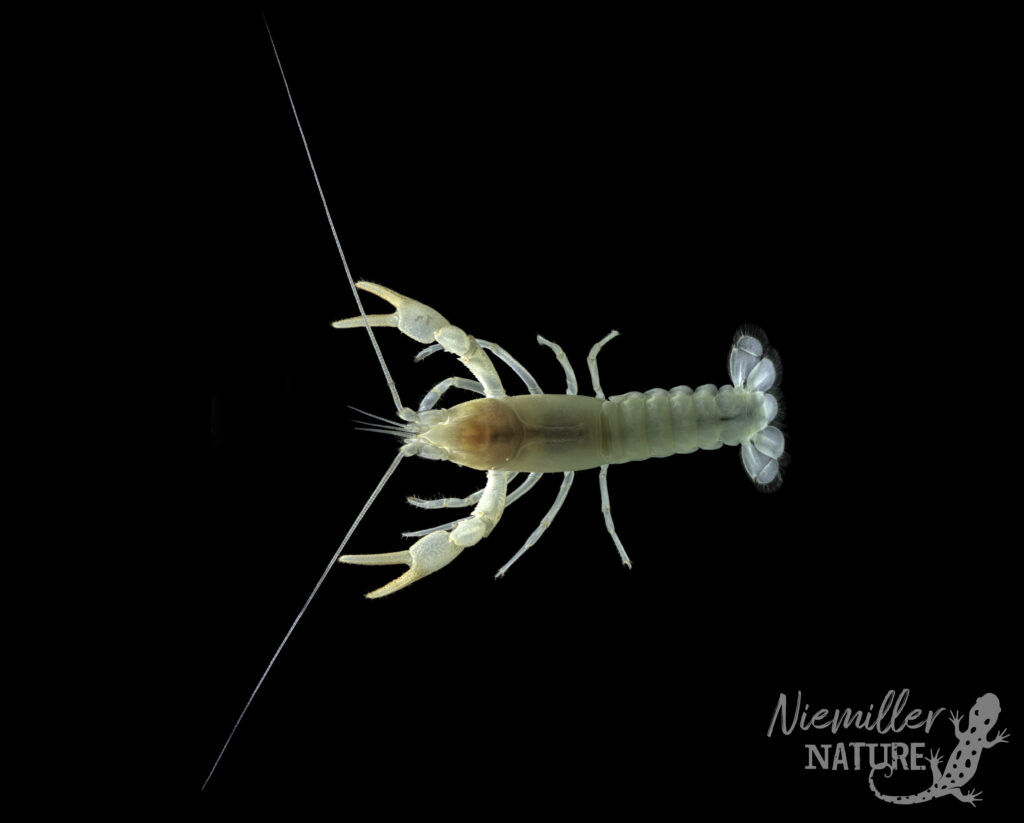
The following morphological description is based on Buhay and Crandall (2009) and Schuster et al. (2022). The Lacon Exit Cave Crayfish is an unpigmented (albinistic) crayfish with unpigmented eyes that are reduced in size and that lack facets. The rostrum is moderately excavated with narrow, straight converging margins distinctly offset from the acumen with small terminal spines. The upper surface of the rostrum is concave without a median carina. The acumen margins are narrower than the rostral margins. Areola length is 4.3× areola width, with four punctations at its narrowest point, and it accounts for 40% of the total carapace length. Lateral surface of the carapace with or without an acute spine along the cervical groove. Branchiostegal spines are acute and well-developed. The hepatic area is typically smooth with scattered rounded tubercles. The suborbital angle is lacking. The postorbital ridge is flattened with a small terminal tubercle.
The chelae are elongate with scattered long setae. The palm is quite long with 3–4 irregular rows of small serrate tubercles on the mesial surface and a prominent tubercle on the lower surface at the base of the dactyl. The dactyl and the propodus are straight, and the lateral margin of the propodus lacks crenulations.
The gonopod of form I males terminates in two elements that are each recurved ~45 degrees. The central projection is long and corneous, tapering to an acute tip, without a subapical notch. The mesial process is subequal to the central projection and noncorneous, slightly thicker at its base, tapering and rounded at the tip, without a low caudal knob. The gonopods of form II males are comprised of two noncorneous elements with the mesial process subequal to the central projection. The annulus ventralis of females is oval, broadly rounded caudally with thickened margins, and broader than it is long. The fossa is deep and C-shaped, and the sinus is U-shaped.
In life, coloration is white to cream to light yellow. Some individuals may have some mottling on the carpus and merus.
Body size
Buhay and Crandall (2009) reported that form I males averaged 19.0 mm total carapace length (TCL) (n = 4), form II males averaged 19.3 mm TCL (n = 5), and females averaged 19.8 mm TCL (n = 8). The largest reported individual was an adult female that measured 23.6 mm TCL (Buhay and Crandall 2009).
Type series
Form I male holotype, allotype female, and morphotype form II male are deposited in the National Museum of Natural History (USNM) (USNM 1109970, 1109971, and 1109973, respectively). The type series was collected from Lacon Exit Cave on 8 May 2006 by J.E. Buhay, T. Mann, M. Niemiller, and A. Toon. Paratypes have been deposited at the Monte L. Bean Museum, including a form I male (JC3800), form II male (JC3803), and female (JC3808) as BYUC06-71, and a form II male (JC2540) collected on 27 October 2005 by J.E. Buhay, T. Mann, and G. Moni, as BYUC06-70. Additional paratypes are deposited at USNM as USNM 1109972 (2 form I males JC3801–3802, 3 form II males JC3804–3806, 6 females JC3809–3814, and 4 juveniles JC3807, 3815–3817). Tissue samples from the gills were removed from all voucher specimens and are housed at Brigham Young University (BYU). Tissue from four claws (JC2436–JC2439) without voucher specimens collected on 27 October 2005 by J.E. Buhay, T. Mann, and G. Moni is also housed at BYU.
Similar species
The Lacon Exit Cave Crayfish is similar morphologically to other cave crayfishes occurring in northern Alabama, particularly the Alabama Cave Crayfish (Cambarus jonesi) that also occurs in Morgan County, Alabama, and the Sweet Home Alabama Cave Crayfish (C. speleocoopi) that occurs in northern Alabama. These species together comprise a cryptic species complex. Buhay and Crandall (2009) indicated that differentiating between these species based on morphological characters is not possible, but suggested geographic location and genetics can be employed for species-level identification. Schuster et al. (2022) proposed that the central projection of the male gonopod can be used to separate the Lacon Exit Cave Crayfish from the other two species. In Lacon Exit Cave Crayfish, the central projection is recurved about 45 degrees, whereas the central projection is recurved at least 90 degrees in the other two species.
Similar species
Distribution
Type locality
Lacon Exit Cave, Morgan Co. AL
Range
Known from one county in Alabama in the Interior Low Plateau karst region.
Continent
North America
Country
United States
States and provinces
Alabama
Counties
- Alabama
- Morgan
Karst regions
Interior Low Plateau
Physiographic province
Appalachian Highlands, Appalachian Plateaus, Cumberland Plateau, Warrior Basin
Range metrics
- Number of occurrences
- 1
- Extent of occurrence
- 1 km²
- Area of occupancy
- 1 km²
Habitat
- Aquatic habitat
- Cave stream, Cave pool
- Cave zone
- Deep cave
The Lacon Exit Cave Crayfish is known only from Lacon Exit Cave, a small cave system in southern Morgan County, Alabama. The cave has a mapped length of 147 m, characterized as a wet-weather stream passage trending east to west and never exceeding 2.1 m in height. The cave stream issues as a wet-weather spring at the entrance. Throughout much of the year, the stream passage consists of isolated, shallow pools with sand, silt, gravel, and cobble substrates. During periods of heavy precipitation, water levels in the cave rise, and these pools become interconnected. Lacon Exit Cave Crayfish have been observed throughout the cave, in stream pools and in narrow channels with bedrock substrate connecting pools.
Ecology and life history
Reproduction
Little is known about reproduction and other aspects of the life history and ecology of Lacon Exit Cave Crayfish. Form I males have been observed in May, June, and October (Buhay and Crandall 2009; Schuster et al. 2022). No ovigerous females or females carrying young have been observed.
Development
Unknown.
Diet
Unknown.
Predators
Unknown, but Spring Salamanders (Gyrinophilus porphyriticus), Red Salamanders (Pseudotriton ruber), and larger Cavespring Crayfish (Cambarus tenebrosus) are potential predators.
Population ecology
Nineteen individuals were observed during the initial survey at Lacon Exit Cave in October 2005. A survey in May 2007 yielded 33 individuals. Across 10 surveys from 2013 to 2025, just 18 individuals have been observed.
Community associates
Aquatic ecological associates of the Lacon Exit Cave Crayfish include Cambarus tenebrosus, C. striatus, Caecidotea bicrenata, Crangonyx cf. antennatus, and larvae of the salamanders Eurycea lucifuga, E. longicauda, Gyrinophilus porphyritricus, and Pseudotriton ruber.
Diseases and parasites
Diseases unknown. Entocytherid ostracods have been observed on the carapace and chelae of some individuals.
Behavior
Unknown.
Genetics
Phylogenetics
Several phylogenetic studies support the placement of Cambarus laconensis in a clade with other Cambarus cave crayfishes from northern Alabama (Buhay et al. 2007; Breinholt et al. 2012; Dooley et al. 2022). However, relationships among these species remain unclear. Buhay et al. (2007) reported the results of maximum likelihood (ML) and Bayesian analyses of mitochondrial 16S and a partitioned, concatenated analysis of three mitochondrial (CO1, 16S, and 12S) and two nuclear (GAPDH and H3) loci. In the 16S analyses, C. laconensis and C. jonesi were sister species with weak support, whereas C. laconensis was sister to C. hamulatus with some support in the concatenated analyses. This relationship was also recovered by Stern et al. (2017), who used a similar dataset (mitochondrial CO1, 16S, and 12S, and nuclear 18S, 28S, and H3 loci) in their ML analysis. Breinholt et al. (2012) employed partitioned, concatenated maximum likelihood and Bayesian analyses of three mitochondrial (CO1, 16S, and 12S) and one nuclear (28S) loci. In their analyses, C. laconensis and C. jonesi were sister species with moderate support. This relationship was also moderately supported using a similar partitioned, concatenated dataset in Owen et al. (2015).
Population genetics
Buhay et al. (2007) reported three distinct mitochondrial 16S haplotypes among five individuals sequenced. 16S genetic diversity reported as Θπ was 0.00206 ± 0.00057.
Molecular resources
| Marker | Molecule | Sequences | Length | Exemplar |
|---|---|---|---|---|
| 16S | mitochondrial | 7 | 485-485 bp | EU433908.1 |
| 12S | mitochondrial | 1 | 330-330 bp | DQ411728.1 |
| 28S | nuclear | 1 | 784-784 bp | JX514643.1 |
| COI | mitochondrial | 1 | 678-678 bp | DQ411782.1 |
| H3 | nuclear | 1 | 356-356 bp | DQ411801.1 |
| other | unknown | 1 | 834-834 bp | DQ411793.1 |
12 sequences, retrieved 23 August 2026. Counts change as sequences are deposited. Search GenBank.
Download all 12 sequence records (CSV) Accession, marker, molecule type, length, GenBank definition and a direct link.
Specimens
Type material
- Holotype
- USNM 1109970 · National Museum of Natural History, Smithsonian Institution
- Allotype
- USNM 1109971 · National Museum of Natural History, Smithsonian Institution
- Paratype ×5
- National Museum of Natural History, Smithsonian Institution
Collections holding material
| Institution | Lots |
|---|---|
| National Museum of Natural History, Smithsonian Institution | 7 |
| Illinois Natural History Survey | 1 |
8 cataloged lots in 2 collections. Compiled from GBIF and not an exhaustive census: many collections are not yet digitised, and holdings are added continually. Search GBIF for specimen records.
Download all 8 specimen records (CSV) Institution, catalog number, type status and preparation. No coordinates.
Conservation and management
IUCN Red List
CR Critically Endangered B1ab(iii)
Assessed by Crandall and Cordeiro in 2010.
The Lacon Exit Cave Crayfish has been assessed as Critically Endangered B1ab(iii). This species is known from one location, and although it is suspected to occur elsewhere, it has not been found despite extensive survey work. Furthermore, the type locality has been degraded by road construction, and its habitat is in continued decline due to road pollution. Further research is required to determine the abundance of this species, whether it occurs in additional locations, and the extent to which it is affected by threats.
NatureServe
G1 Critically Imperiled
Global rank last reviewed 17 May 2010.
The Lacon Exit Cave Crayfish is endemic to Morgan County, Alabama, south of the Tennessee River along Interstate 65 in only a single cave. Furthermore, the type locality has been degraded by road construction, and its habitat is in continued decline due to road pollution. Further research is required to determine the abundance of this species, whether it occurs in additional locations, and the extent to which it is affected by threats (NatureServe 2026).
Subnational ranks
- Alabama
- S1 Critically Imperiled
Ranks looked up 23 August 2026. Conservation status changes, and a rank here is as current as that date and no more.
State and federal status
Not listed under the U.S. Endangered Species Act.
State Protected in Alabama under 220-2-.98 (Invertebrate Species Regulation) and a Priority 1 Species (Highest Conservation Concern) under the State Wildlife Action Plan in Alabama (Alabama Department of Conservation and Natural Resources 2015). No federal protection.
Schuster et al. (2022) proposed a conservation status of Endangered based on criteria by the American Fisheries Society. The conservation status of the Lacon Exit Cave Crayfish also was reported in Simon (2011).
Threats
- Pollution -Sewage or Urban Wastewater
- Pollution - Commercial/Industrial
Lacon Exit Cave was discovered after it was blasted open during construction of the Lacon exit of Interstate 65. There may be some impacts to groundwater quality due to the proximity to Interstate 65. Recent surveys of Lacon Exit Cave since November 2018 have reported significant deposits of sand and silt throughout the cave system. Some pools where the species had been observed previously in the mid-2000s were filled with sediment. The exact source of the sediments is currently unknown but may be upstream development in the cave’s recharge basin. Over 20 individuals were collected in the mid-2000s for taxonomic and genetic studies, many of which were accessioned into museum collections as part of the type series. The impact of this level of scientific collection on the population is unknown.
Distribution and population trends
Decreasing
The distribution of the Lacon Exit Cave Crayfish has remained unchanged since its discovery.
Population size estimates of the Lacon Exit Cave Crayfish are unknown. Population trends are based on visual census counts during biosurveys. Surveys in 2005 and 2007 reported 19 and 33 individuals, respectively. The species was not observed over four surveys from 2018 to early 2025 but 0 to 5 individuals were observed during four surveys from August to December 2025. At least 18 individuals were collected in May 2006 (Buhay and Crandall 2009).
Conservation actions
Management recommendations include establishment of regular monitoring of groundwater quality and other threats and surveys for the crayfish population at Lacon Exit Cave and other surrounding caves to more accurately determine the status of the species. Studies focusing on the life history and ecology of the species also are greatly needed (Huryn 2017).
Comments
The species was first discovered in 2005 when Will Drake, an undergraduate student from Alabama attending Brigham Young University, observed white cave crayfish in Lacon Exit Cave during a mapping survey. Drake informed Jen Buhay, a Ph.D. student at the time at BYU in Dr. Keith Crandall’s lab, about the sighting. Buhay, Gerald Moni, and Thany Mann confirmed the observation in October 2005 (Buhay and Crandall 2009).
Other resources
References
- Breinholt, J.W., Porter, M.L. & Crandall, K.A. 2012. Testing phylogenetic hypotheses of the subgenera of the freshwater crayfish genus Cambarus (Decapoda: Cambaridae). PLoS One 7(9): e46105. doi:10.1371/journal.pone.0046105
- Buhay, J.E. & Crandall, K.A. 2009. Taxonomic revision of cave crayfish in the genus Cambarus, subgenus Aviticambarus (Decapoda: Cambaridae) with descriptions of two new species, C. speleocoopi and C.laconensis, endemic to Alabama, U.S.A. Journal of Crustacean Biology 29(1): 121–134. doi:10.1651/08-3089.1
- Buhay, J.E., Moni, G., Mann, N. & Crandall, K.A. 2007. Molecular taxonomy in the dark: evolutionary history, phylogeography, and diversity of cave crayfish in the subgenus Aviticambarus, genus Cambarus. Molecular Phylogenetics and Evolution 42(2): 435–448. doi:10.1016/j.ympev.2006.07.014
- Crandall, K.A. & Cordeiro, J. 2010. Cambarus laconensis. The IUCN Red List of Threatened Species 2010: e.T164914A5937870. Accessed 27 August 2026. doi:10.2305/IUCN.UK.2010-3.RLTS.T164914A5937870.en
- Engel, A.S. & Niemiller, M.L. 2024. The Southern Cumberland Plateau. In: Weaver, A. (ed), 2024 NSS Convention Guidebook: TAG Tour 2024, pp. 24–30. National Speleological Society, Huntsville, Alabama, USA.
- Huryn, A.D. 2017a. Lacon Exit Cave Crayfish Cambarus laconensis Buhay and Crandall. In: Shelton-Nix, E. (ed), Alabama Wildlife, Volume 5, p. 99. The University of Alabama Press, Tuscaloosa, Alabama, USA.
- Schuster, G.A., Taylor, C.A. & McGregor, S.W. 2022. Crayfishes of Alabama. University of Alabama Press, Tuscaloosa, Alabama, USA. 496 pp.
- Simon, T.P. 2011. Conservation status of North American freshwater crayfish (Decapoda: Cambaridae) from the southern United States. Proceedings of the Indiana Academy of Science 120(1–2): 71–95. https://journals.indianapolis.iu.edu/index.php/ias/article/download/21024/20442/0. details
- Stern, D.B., Breinholt, J., Pedraza-Lara, C., Lopez-Mejia, M., Owen, C.L., Bracken-Grissom, H., Fetzner, J.W., Jr. & Crandall, K.A. 2017. Phylogenetic evidence from freshwater crayfishes that cave adaptation is not an evolutionary dead-end. Evolution 71(10): 2522–2532. doi:10.1111/evo.13326
- Tennessee Cave Survey. 2005. Biological records from Tennessee, Alabama, and Georgia caves. Tennessee Cave Survey.
This account was last revised 3 September 2026. Conservation ranks were looked up 23 August 2026.
How to cite this account
Account author Matthew L. Niemiller
Data sources and funding are listed in the Acknowledgments.
Spotted something wrong on this page? Report a correction. Accounts are compiled from many sources and corrections from people who know the group are the most useful email we get.