Hidden River Cave
Hart County, Kentucky
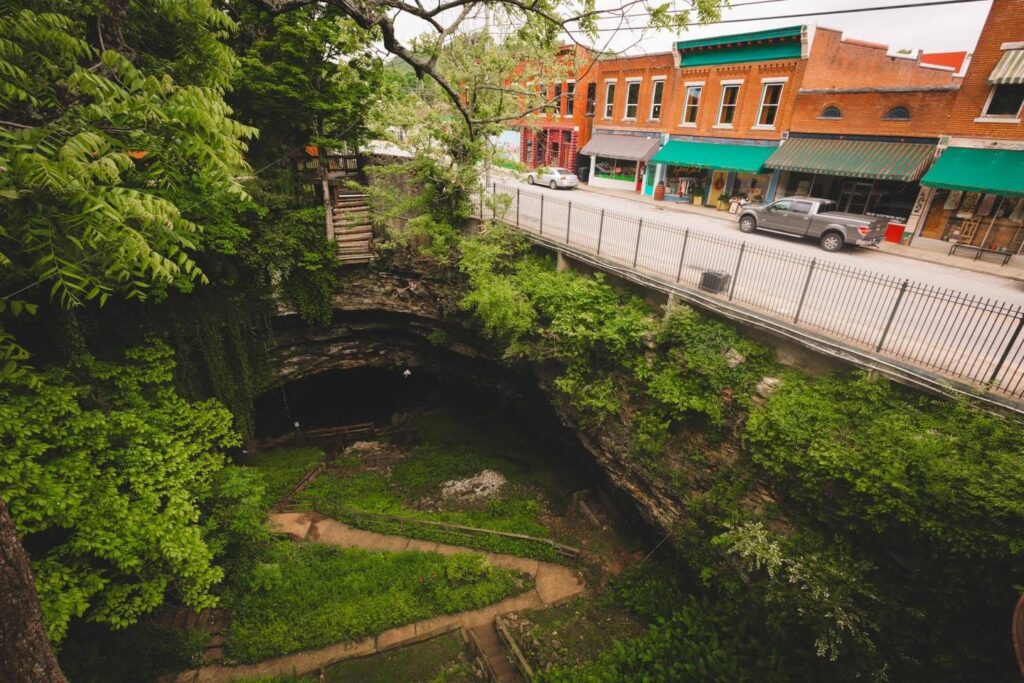
Hidden River Cave opens directly beneath Main Street in Horse Cave, Kentucky. Its underground river supplied the town's drinking water and, from the 1890s, its electricity, making Horse Cave the first town in Kentucky with incandescent lighting. Tours ran from 1912 until 1943.
The tour crosses a 100-foot suspension bridge into Sunset Dome, a chamber roughly 250 feet across and 100 feet high. The American Cave Museum at the entrance covers karst hydrology and the cave's own history.
Visiting
- Operated by
- American Cave Conservation Association
- Address
- 119 East Main Street, Horse Cave, KY 42749
- Season
- Daily
- Tours
- Walking, Wild
- Accessibility
- Many steps
- Telephone
- 270-786-1466
Opening times and tickets Directions
The map is loaded from Google, which will see your request. It is not loaded until you press the button.
Check with the cave before traveling. Seasons and times change, and this page is not maintained by the operator.
What lives here
For most of the twentieth century there was almost nothing living here. The town discharged sewage and industrial waste into sinkholes that drained straight into the cave, and by the 1940s the smell had closed the tours. A gasoline leak in 1975 added thousands of gallons more. The stream held sewage bacteria and bloodworms, and the cavefish and cave crayfish that had once been abundant were gone.
A regional sewage treatment plant opened in December 1989. Cave crayfish were back in the previously polluted passages by the summer of 1991. A biological inventory begun in 2013 by Julian and Salisa Lewis found the cave supporting 21 obligate subterranean species, and by 2015 water quality had recovered to near drinking water standards. The cave was placed under permanent easement in 2015.
Recovery from that degree of contamination has no clear precedent, and the cave is now cited as a case that other polluted karst systems might follow.
Species recorded here
| Species | Common name | Class | Status |
|---|---|---|---|
| Scoterpes copei | Troglobiont | G3G4 | |
| Phalangodes armata | Troglobiont | G3G4 | |
| Typhlichthys subterraneus | Southern Cavefish | Stygobiont | G4 |
| Orconectes pellucidus | Mammoth Cave Crayfish | Stygobiont | G4 |
| Neaphaenops tellkampfi | Troglobiont | G3G4 | |
| Caecidotea bicrenata | Two-toothed Cave Isopod | Stygobiont | G5 |
| Carychium stygium | Cave thorn | Troglobiont | G3 |
| Crangonyx packardi | Packard's Cave Amphipod | Stygobiont | G4 |
| Phanetta subterranea | Subterranean Sheetweb Spider | Troglobiont | G5 |
| Litocampa cookei | Cooke's Cave Dipluran | Troglobiont | G5 |
Recorded here in the published literature. Most are small, most live beyond the lit sections, and you are unlikely to see them on a tour.
What you might actually see
Blind Southern Cavefish and Mammoth Cave Crayfish are visible in the stream. Cave beetles, cave diplurans, cave harvestmen, and cave millipedes are common in the Sunset Dome area. Ask your guide where to look.
Looking after it
- Do not touch, collect, or move anything living.
- Keep to the trail. The mud beside it is habitat.
- Clean and dry your gear between caves: white-nose syndrome travels on clothing.
- Ask your guide what lives there. Most know, and are rarely asked.
More about the subterranean fauna of Kentucky · Interior Low Plateau karst